Submitted: Tiffany Koehler, 3rd Junior Vice Commander
 Posted by: Jim on January 1 2023 12:44:03.
Submitted: Tiffany Koehler, 3rd Junior Vice Commander
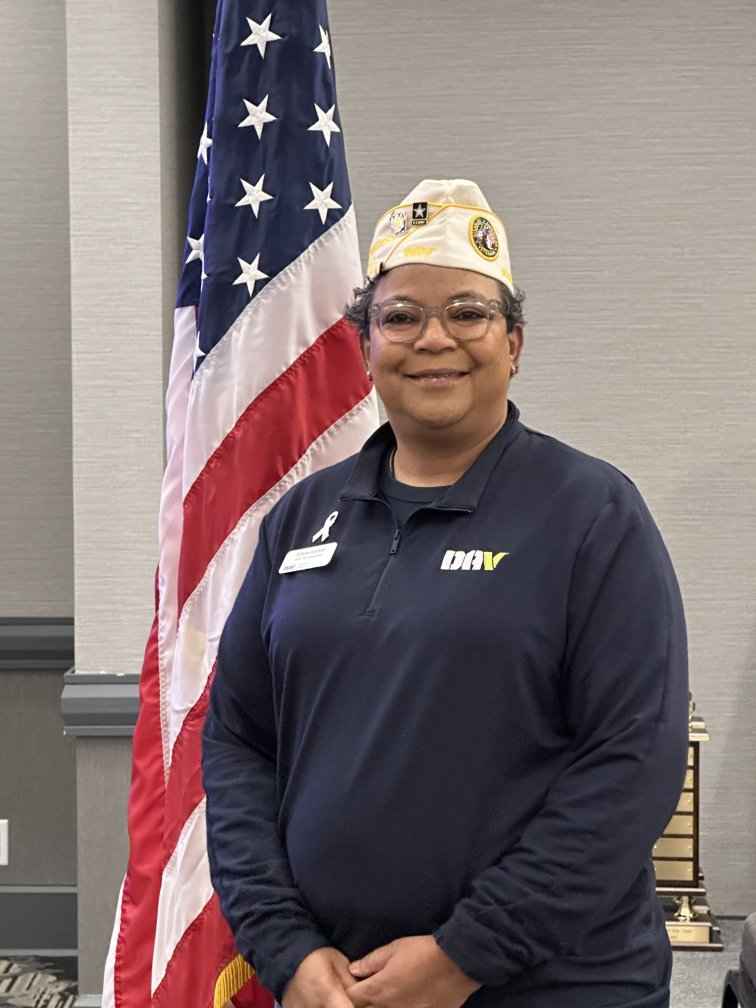
As the former chair of the Disabled American Veterans (DAV) Wisconsin’s Women Veteran Committee, I was happy to report that all of DAV Wisconsin’s executive team and DAV members at our fall conference took the Veterans Administration’s (VA) White Ribbon Campaign’s pledge to support the end of sexual harassment and sexual assault at VA facilities and clinics. DAV Wisconsin Veterans raised their right hand if abled and stated their names and said the following, “ I pledge to never commit, excuse, or stay silent about sexual harassment, sexual assault or domestic violence against others.” I further stated that it was important not only to say the pledge rather to live the pledge in all places and spaces.
The White Ribbon Campaign is a national call to action by the VA to eliminate sexual harassment, sexual assault, and domestic violence across the VA by promoting a constructive change in culture so that the actions outlined in the pledge become the organizational norm. White Ribbon Campaign is an awareness movement where all can participate.
The White Ribbon Campaign was inspired by the White Ribbon organization which is ,based in Toronto, Ontario Canada, the world’s largest movement of men and boys working to end violence against women and girls, and to promote gender equity and healthy relationships. Since its inception in Toronto in 1991, the White Ribbon Campaign has spread to over 60 countries around the world, including college campuses, military bases, and stations, within several states across the country, and now DAV Wisconsin, we are proud to lead the way and encourage other Veteran Service Organizations to take the pledge.
Reference: U.S. Veteran Affairs Administration,(October 3, 2022). Retrieved on December 15, 2022, from https://www.va.gov/health/harassment-free/






Help with Getting your Posts to Display Immediate
 Posted by: Admin on October 3 2022 10:36:02.
The system defaults to not displaying immediately.
To get it to display immediately, simple set the "Delay the display of this post?: " drop-down menu to Y, then in the date picker box, select yesterdays date. Or, select whatever date you want the post to begin showing.
There is value in the system defauting to NOT displaying, as this allows you to edit the post, then share it when ready.
I hope this helps, If you have a question, email me at docp@partnerwebhosting.com
Regards,
Doc
Doc Palmere, Ph.D.
Dav-wi.org Script Installer
Group Leader/Owner, PartnerWebHosting.com LLC
[Note: this post was formated using size 16 font, using font Veranda. All letters were set to boldface for easier reading]
Last Revised; Oct-3-2022 @ 10:45am
VeteranOfTheDay Army Veteran Charles W. Whittlesey
 Posted by: Fred on October 2 2022 17:02:31.
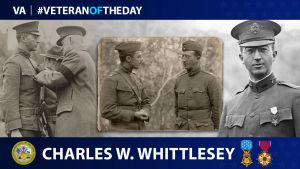
#VeteranOfTheDay Army Veteran Charles W. Whittlesey
September 30, 2022: Charles W. WhittleseyWorld War I saw innumerable valorous and heroic acts. In October 1918, during the Meuse-Argonne Offensive, Army Maj. Charles W. Whittlesey and his battalion of the 77th Division, the 308th Infantry, stood their ground for five days straight. Without food, supplies or reinforcements, they held out against the onslaught of German forces, which ultimately broke against the iron will of Whittlesey and his men. His action and resolve brought forth a legend that would never be forgotten: The Lost Battalion.
Born in Florence, Wisconsin, in January 1884, he was the eldest of four boys to Frank and Annie Whittlesey. When he was still a child, the family moved to Pittsfield, Massachusetts, because his father acquired a position with General Electric. He would graduate from the Pittsfield High School and later graduated from Williams College, as a member of the Delta Psi fraternity. Whittlesey would eventually graduate from Harvard Law School in 1908. He then traveled to New York and spent three years with a private firm, before practicing law in 1911 with a friend and classmate, J. Bayard Pruyn.
Whittlesey worked for six years before taking a leave of absence once the United States entered the Great War. He joined the Army and was shipped to France as captain in the Army’s 77th Division. Known as the “Metropolitan Division,” it was mostly composed of men from nearly every culture in New York City, many of whom resided in the Lower East side and were sons of immigrants. By that September, Whittlesey was promoted to major and the 308th would endure the effects of trench warfare for a solid year before any true offensive was taken.
Whittlesey had come to admire, respect and care for his men greatly. When he and the 554 soldiers serving under him were ordered to assault a heavily fortified German position, he argued that it was suicide. This assault would become part of the Meuse-Argonne Offensive, which was the largest offensive that the United States ever completed. It was also the last major offensive that contributed to ending the war, since it allowed American troops to advance through Belgium and France.
Whittlesey, despite his opinions on the matter, obeyed the orders of his commanders and led his men in the assault on Oct. 2, 1918. His attack was successful, suffering mild losses and capturing his objective. However, since his battalion had assaulted the center position of the German defense, it risked encirclement. This was what happened when the French battalion covering his right flank broke and a fellow American Battalion on the left flank scattered, causing Whittlesey and his troops to be pinned down by German snipers and trench mortars. Their supplies were cut off, they were running low on ammunition, and they were out of food, water and medical supplies. Luckily, the reinforcements they acquired were the remnants of the 307th Infantry, who were supposed to be on the left flank but were overwhelmed by German forces.
The two infantry battalions merged. For five, brutal days, the men of Maj. Whittlesey fought tooth and nail to hold their ground. On Oct. 6, the German commander sent terms for surrender to Whittlesey, who promptly refused. After air reconnaissance missions, his men were found and rescued on Oct. 7. Of the 554 soldiers of Whittlesey’s original 308th, 107 had been killed, 63 were missing and 190 were wounded, including second in command, Capt. George McMurtry. Only 194 men were able to walk away from the Argonne.
Whittlesey would be promoted to lieutenant colonel and then relieved of further duties on Oct. 29. He was honorably discharged on Dec. 5th. After the war, he tried to return to law, but he found all the attention of being a war hero uncomfortable, as he strongly believed that his men deserved all the credit from the five-day assault. His dedication and loyalty to the men of his “Lost Battalion” were so great that, one time, he left his bed sick to attend the funeral of a private who served under him.
Whittlesey died at the age of 37 on Nov. 30, 1921.
We honor his service!
VeteranOfTheDay Marine Corps Veteran Ronald L. Green
Posted by: Fred on October 2 2022 16:56:23.
#VeteranOfTheDay Marine Corps Veteran Ronald L. Green
September 28, 2022: Ronald L. GreenRonald L. Green, a native of Jackson, Mississippi, enlisted in the Marine Corps in 1983. He attended recruit training at Marine Corps Recruit Depot at Parris Island in South Carolina. In March 1984, he was stationed at Camp Pendleton, California, where he served as a field artillery cannoneer in the 11th Marine Regiment. He then reported to Okinawa, Japan, in 1985 and was assigned to Delta Battery, 2nd Battalion, 12th Marine Regiment.
In 1987, Green attended Nuclear Field Artillery School and earned the military occupational specialty of Field Artillery Nuclear Projectile man. In 1988, he served as the tower operator for Southern Impact Area Control, or “Long Rifle,” at Marine Corps Base Camp Pendleton. In 1990, he served as a drill instructor at Parris Island.
Green returned to Camp Pendleton in 1992 as a section chief for the 11th Marine Regiment. In 1993, he deployed to Somalia during Operation Restore Hope with the 13th Marine Expeditionary Unit (Special Operations Capable). He returned to the 11th Marine Regiment as the battery gunnery sergeant. After this assignment, he served as the assistant marine officer instructor at Southern University and A&M College in Baton Rouge, Louisiana.
He deployed to South America to support Operation United Americas (UNITAS) for seven months in 2001 with the 23rd Marine Regiment. In 2006, he deployed for seven months with the Marine Light Attack Helicopter Squadron 169 during Operation Iraqi Freedom. In February 2007, he assumed the role of squadron sergeant major for the Marine Aviation Logistics Squadron, 39. In 2010, Green reported to the post of sergeant major for Marine Corps Forces Europe/Marine Corps Forces Africa, in Stuttgart, Germany.
Green returned to Camp Pendleton in 2012 and assumed the role of I Marine Expeditionary Force sergeant major. On Jan. 20, 2015, Green was selected to be the 18th sergeant major of the Marine Corps by Gen. Joseph F. Dunford. He assumed the post on Feb. 20, 2015, and served four years and five months, becoming the longest-serving sergeant major of the Marine Corps. Green retired in 2019 as sergeant major of the Marine Corps.
Green was awarded the Navy Distinguished Service Medal, the Legion of Merit with two Gold Stars, a Meritorious Service Medal, the Navy and Marine Corps Commendation Medal with four Gold Stars, and the Navy and Marine Corps Achievement Medal with two Gold Stars. He earned a B.S. in Cybersecurity and an M.S. in Cybersecurity Policy from the University of Maryland and co-authored the NATO non-commissioned officer’s professional military education reference curriculum.
Thank you for your service.
Played with Younger and James Boys
Posted by: Jim on September 16 2022 10:05:17.
Wisconsin man, 94, Recalls Thrills of Civil War Days in the border Country.
Good Afternoon my fellow DAV Wisconsin Members,
I thought I would start this Blog off with a little bit of personal history.
The following article was printed in 1920 either in the Marinette Eagle Star or the Peshtigo Times.
I have the original clipping and there is a partial article on the back of this clipping referring to it being 1920.
The article is an interview with my Great Great Grandfather Andrew J. Smith.
What is striking to me is how well this article is written.
The reporter most certainly has style and took his job very seriously.
I've enjoyed reading this personal piece of family history from time to time and I hope that our brothers and sisters in arms here in the DAV-Wisconsin Blog do so also. So without any further ado, I will repost the article as written in 1920.
Played With Younger and James Boys
Wisconsin man, 94, Recalls Thrills of Civil War Days in the border Country.
Marinette, Wis. – the James boys, before the Civil war, were quite respectable citizens, declares Andrew J. Smith, 94-year-old “mayor of Bagley Junction.” Mr. Smith, as a young man, spent many afternoons at pistol practice with the brothers who in later years became notorious out-laws.
Bagley Junction is a hamlet of two or three families about 16 miles west of here, and Mr. Smith has become “mayor” by virtue of being the oldest citizen there. He spends the summers at “the junction” in his small cottage on the Peshtigo river.
“The James boys and the Younger brothers, who later became members of the same gang, were excellent shots,” says Mr. Smith. “I often beat them in our pistol practice, though, for I could stack five bullets in the bull’s eye at 15 to 40 yards. “The boys were all right and were law-abiding until the war. Then they joined a guerrilla band, which was fighting against the North. What was of the band after the war became a gang of desperadoes.”
A Narrow Escape
Mr. Smith lived several years on a little farm about 50 miles west of Hannibal, Mo. when that region was sparsely peopled. The sympathy of the community was overwhelming with the Confederacy when the Civil war broke out, and Mr. Smith’s loyalty to the North almost cost him his life at the hands of his neighbors. “I was the only person in the vicinity to refuse to sign the paper that was circulated, declaring allegiance to Gov. Jackson and the state of Missouri, which the governor was trying to throw to the side of the South,” Mr. Smith said.
“From the day I refused to sign that paper I knew my life wasn’t safe or the lives of my wife and baby. For several nights, I slept outside the door of my house with a shotgun and two pistols, determined to shoot as many as possible before they should kill me.
“One day I learned that a posse was coming to take me away in the night and hang me. Heavily armed and riding a 2-year-old mule, I left my wife and baby boy, who was just a year old, and started for Hannibal, where I knew there was a garrison of federal troops. I rode all night and covered nearly 50 miles.
A Posse of 30 was following me, and shortly after daybreak the road they were on converged with the one I was following. There was a bridge ahead, and they saw me as I rode out into the open to cross the span. The whole troop opened fire, but I was not his. A scouting party of Union soldiers from Hannibal happened to be in the vicinity and hearing the shots rode to the other side of the bridge. They returned the fire of my pursuers and I was safe.”
Enlisted in Illinois
Mr. Smith a few days later crossed the Mississippi into Pike country, Illinois, where he enlisted in the Co. D, 99th Illinois infantry, in which unit he remained throughout the war. His regiment, of which he now is the only survivor, was with Gen. Grant all through the Vicksburg siege. Asked if he were wounded in any of his engagements, the aged veteran answered: “only slightly. I was wounded in the leg once, and another time a bullet cut the skin on my cheekbone. I had the breech shot off my gun at Vicksburg, but there were plenty of guns handy that were not in use.”
Asked what happened to his wife and baby, Mr. Smith said, “I had given a neighbor $40 to take them over to Illinois. At the risk of being shot to death, he smuggled them out of the neighborhood one night.”
The son, who for many years was head of a Marinette county institution died about a year ago. Three other children were born to the couple, one of whom is living. Of four born after Mr. Smith’s second marriage, three are living.
Of Quaker ancestry, Mr. Smith is a native of Washington, Pa. For a time he attended a Quaker school. When still in his teens, he obtained work driving a 6-horse team hauling freight from Washington to Pittsburgh.
“I worked at that six years, “ Mr. Smith recalls. “Then for three years, I drove a stagecoach east from Washington to Carlisle over the old National pike and the Williamsport pike. That was before there was a railroad through western Pennsylvania. I remember well when the Pennsylvania line was put through, went through the Johnstown tunnel on the first passenger train that was run over the road.”
To Marinette in ’71.
Mr. Smith left Pennsylvania in 1857, going to Illinois. From there he went over into Missouri. He returned to Illinois following the war and came to Marinette in 1871. Trees four feet in diameter stood in what is now the main part of this city, he says. The village consisted of two or three stores and saloons and a few homes.
Fifty-two years ago Mr. Smith took up a homestead near her. The hardships particularly in the winter were so great that he soon abandoned the farm and again lived in Marinette. For 29 years he was engaged as a lumber cruiser, traveling on foot over northern Wisconsin and Michigan appraising timber. “I can remember spending as much as four weeks in the woods without seeing a white man, “ the old man recalls. “There were many bears and wolves, and the deer were so thick that one could have killed hundreds of them at certain seasons. This was a wonderful country then.”
Although now almost blind, Mr. Smith is remarkably active for one of his years. He walks briskly over paths about his cottage.
The rigors of the winters in recent years have driven Mr. Smith and his wife to spend the winter months with a daughter in Manitowoc. But each year, when spring comes, the doughty “mayor” insists o getting back to the north woods and his cottage at Bagley Junction.
Submitted: Tiffany Koehler, 3rd Junior Vice Commander
Posted on January 1 2023 12:44:03 by Jim.

Help with Getting your Posts to Display Immediate
Posted on October 3 2022 10:36:02 by Admin.
VeteranOfTheDay Army Veteran Charles W. Whittlesey
Posted on October 2 2022 17:02:31 by Fred.

VeteranOfTheDay Marine Corps Veteran Ronald L. Green
Posted on October 2 2022 16:56:23 by Fred.

Played with Younger and James Boys
Posted on September 16 2022 10:05:17 by Jim.
| [1] |
|---|